Novita P9 Instant Hot/Cold Water Dispenser With Ice Maker
.png) Hot water without waiting for a kettle. Cold water without a jug in the fridge. Ice without a tray you forget to refill. That is the pitch for the Novita P9, a tankless dispenser that does all three from one body — and it is a genuinely useful thing in a hot, humid kitchen where the kettle gets boiled five times a day.
But "three functions in one box" is not the same as three functions done well, and the details that decide whether you will love it or resent it are rarely on the marketing banner. This page is about what this class of dispenser actually changes in a household, and what to check before you commit.
What "Instant" Actually Means
Hot water without the kettle ritual
.png) The difference is not temperature — it is the waiting and the walking. A kettle means filling, boiling, pouring, and repeating. An instant hot tap means the water is there when you press, which changes how often you use it: the cup of tea becomes automatic rather than a decision. In a household where someone drinks hot water all day, that is the feature that earns its place.
The honest caveat is that hot water arrives at a temperature meant for drinking and brewing, not for cooking volumes. If you regularly fill a pot for pasta, you will still use the stove.
Cold water without a fridge jug
A jug in the fridge takes up shelf space, empties without warning, and gets its water from a tap that is warm in a Singapore kitchen almost year-round. A chilled line solves a specific annoyance: water that is actually cold when you want it, and no shelf sacrificed to hold it.
If your household drinks mostly room-temperature water and keeps a bottle in the fridge door, this is the function you will use least — and the one worth cost-checking first.
Ice, and who really uses it
Ice makers are the function people buy for and use least, or buy without and then miss. The test is not whether ice sounds appealing but whether anyone in the house currently makes it: cocktails, iced coffee, cold drinks for guests, a child who wants ice in everything.
If nobody reaches for ice today, an ice-making model is capacity you are paying for and cleaning. If someone does, it is the single most convenient thing in the machine — no trays, no freezer space, no forgetting.
Why Tankless Matters More Than It Sounds
There is no tank to refill
The word "tankless" is doing a lot of quiet work here. A tank-based dispenser asks you to carry water to it — a jug, a bottle, a refill several times a day for a family that drinks a lot. That routine is invisible in a showroom and very visible in week three, when the novelty has worn off and someone still has to fill it.
A unit that connects to a supply removes that chore entirely. It is the difference between an appliance that runs itself and one that needs feeding.
What it asks of you instead
Nothing about this is free. A connected unit asks for a water point where you want it, which usually means a kitchen and sometimes a small amount of installation. It asks for counter or under-counter space, and it asks to be connected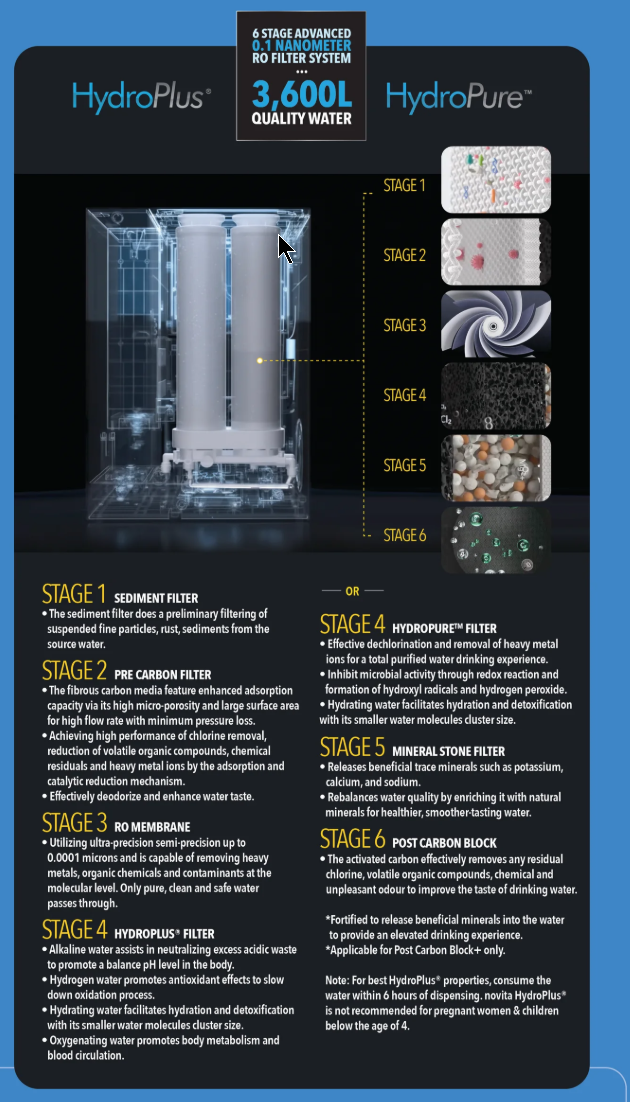 properly rather than perched wherever is convenient.
A portable unit asks for none of that — and asks for refills instead. Which of the two trades is better depends entirely on your flat, not on which unit is "better".
Filtration, Honestly
Singapore tap water is already treated
It is worth stating plainly, because a great deal of dispenser marketing implies otherwise: Singapore's tap water is treated to a PUB standard and is safe to drink as it comes out of the tap. Nothing downstream of that is rescuing your water.
That single fact reframes the whole filtration conversation. A filter is a refinement on top of water that is already safe — a convenience and a taste decision, not a safety measure.
What a filter stage is actually for
Described in plain terms, filtration reduces sediment and fine particles, and it reduces the chlorine taste and odour that come with any treated public supply. That is the honest description. If a filter is marketed in terms that sound like medical outcomes, treat that as a signal to ask what the filter is genuinely designed to reduce.
Replacement is a commitment, not a feature
Every filter is a recurring cost and a recurring task. Before buying, ask how replacements are obtained, how often they are needed, whether you can fit them yourself, and what happens if you forget. A unit whose filters are awkward to source becomes a unit nobody maintains — and an unmaintained filter is worse than no filter at all.
There is also a legitimate answer that the industry rarely offers: a dispenser without filtration is a perfectly reasonable choice. Fewer parts, less to neglect, one less thing to remember.
Living With It
Space and placement
Three functions in one body is a space story as much as a convenience one — it replaces a kettle, a jug and possibly an ice tray with a single footprint. But that footprint is real, and it has to go somewhere that works: near a water point if connected, near where drinks are actually made, and not in the one clear stretch of counter a small kitchen has.
Measure the space before the model. The most common regret is not performance — it is discovering the only place it fits is the place you did not want it.
Hot water and small children
An instant hot outlet is a real hazard in a house with a toddler, and no amount of convenience changes that. What matters is placement first — height, distance from the edge, whether the child can reach the lever — and features second.
A child lock helps, but it is a backstop, not a substitute for siting the unit somewhere a small hand cannot get to. If you have young children, let where it goes decide which model you buy, not the other way round.
How Much Water Does A Household Actually Need?
Count the drinks, not the people
Manufacturers talk in capacity; households should think in cups. Two adults who drink hot water through the day, a helper who cooks, a teenager who empties a cold jug every evening — that is a very different demand from a couple who mostly drink coffee at work. Count how many times a day the kettle goes on now. That is your honest starting number, and it is usually higher than people guess.
Then add what the tally usually misses: cooking water, guests, and ice. A household that entertains twice a month uses the ice maker in bursts and barely touches it otherwise. A household that never entertains will not use it at all.
The tank question, in practice
This is where the tankless decision comes home. A filled unit holds a fixed amount, and how long it lasts depends entirely on that drinks count. A household that drinks a lot will notice the limit within a day; a small one may refill once a day and never think about it.
The wrong way to buy is to size for the biggest week of the year — the reunion dinner, the party, the visitors. Buy for the ordinary Tuesday. You will refill a little more often during a party, and that is a far smaller annoyance than a machine sized for a life you do not live.
Where the water comes from matters most
If the unit connects to a supply, the capacity question mostly disappears — you are limited by the plumbing, not by a tank. If it is filled by hand, capacity is the feature you will live with most closely. Be honest with yourself about which one you will actually refill, because the refill is what people stop doing.
Three Mistakes That Sink This Purchase
Buying the ice maker and never using the ice. Ice is the most appealing feature in a showroom and the most neglected at home. If nobody in the house currently fills an ice tray, buy the unit for the hot and cold water and treat the ice as a bonus rather than the reason.
Letting the filter be someone else's problem. A filter you forget to change is worse than no filter — and replacement routines fail quietly, over months, in a way nobody notices until the water starts tasting different. Decide in advance who checks it and when, or buy an unfiltered unit and skip the question.
Siting it wherever it fits. These units are bought online, measured by eye, and placed in the last remaining gap on the counter. Then the hot water outlet is where a child can reach it, or the machine is two steps from the sink it needs. Measure the space, and decide where the unit goes before deciding which model you want.
Two Households, Two Answers
A couple in a new flat, renovating the kitchen before they move in, want hot and cold on tap and are happy to plan a water point. For them a connected unit is straightforward and the ice maker gets used — they entertain, and the machine is going in as part of the build anyway. Deciding once is easy when you are already deciding everything else.
A family in an older flat, renting, with counter space at a premium and a landlord who is not going to run plumbing for them, is in the opposite position. A compact unit that sits on the counter, needs no installation, and can move when they do makes far more sense — even though it asks to be refilled.
The difference had nothing to do with which unit performed better. A water point, a lease, and how much counter there is settled it long before the specification did.
What To Check Before You Buy
- Who makes the drinks. Count how often hot water is poured in your house. That number, not the feature list, decides whether the convenience is worth it.
- Whether ice is genuinely used — or merely appealing in a showroom.
- The refill question. If it is a tank unit, who is carrying the water in week three? Name the person.
- Where it will actually sit, measured, in the room where drinks are made.
- Filter logistics, if it has one: cost, frequency, availability, and whether you will do it yourself.
- Placement and safety around hot water, especially with young children in the house.
- What is covered and for how long — and what happens when it needs attention.
The Short Version
The Novita P9 puts hot, cold and ice in one tankless body, and the convenience is real rather than marketed. It is at its best in a household that drinks a lot of hot and cold water, has somewhere sensible to put it, and will actually use the ice.
It is at its worst when bought for the feature list alone — ice nobody uses, filters nobody changes, a unit sited wherever it happened to fit.
So apply the same test to any model, including this one: describe your household first, then match the machine to it. The kitchen happiest with one decided who uses it and where it lives before deciding what to buy.
Novita Singapore — home comfort appliances designed for Singapore conditions. Water dispensers, dehumidifiers and air purifiers: estore.novita.com.sg